
Why Your CBD Supplier's COAs Matter More Than Their Price
Posted by Steve on Jul 31st 2026

Why Your CBD Supplier's COAs Matter More Than Their Price
I've been making CBD gummies by hand in Louisville since 2016. In that time, I've watched hundreds of suppliers come and go—most of them chasing the lowest price point they could advertise. And I've seen what happens to the businesses that chose their CBD supplier based on price alone.
They get burned. Every single time.
Here's the truth that nobody in this industry wants to talk about: CBD wholesale quality isn't determined by what a supplier tells you. It's determined by what their Certificate of Analysis proves. And if you don't know how to read a COA—or worse, if your supplier's COA doesn't hold up to scrutiny—you're putting your entire business at risk.
What Is a COA and Why Should You Care?
A Certificate of Analysis is a document from a third-party laboratory that verifies exactly what's in a CBD product. It tests for cannabinoid potency, contaminants, heavy metals, pesticides, residual solvents, and microbial content.
For retailers and white-label brands, a CBD supplier COA is your insurance policy. It's the difference between selling a legitimate product and selling something that could get you sued, shut down, or worse—hurt someone.
Every batch we produce at Steve's Goods gets a total-THC COA. Every single one. COAs are available for all our products because transparency isn't optional when you're asking someone to trust you with their business.
How to Actually Read a COA
Most people glance at a COA and see a bunch of numbers. Here's what you should actually be looking for:
1. Potency Accuracy
The COA should show cannabinoid percentages that match—or come very close to—what's on the product label. Industry standard allows for about a 10% variance. If a product claims 25mg of CBD per gummy and the COA shows 15mg, that's not a rounding error. That's a problem.
Look for the total CBD, Delta-9 THC (must be under 0.3% for legal hemp), and any other cannabinoids like CBG or CBN if they're advertised.
2. Contaminant Testing

A complete COA tests for:
- Heavy metals (lead, arsenic, mercury, cadmium)
- Pesticides (dozens of compounds)
- Residual solvents (leftover extraction chemicals)
- Microbial contamination (mold, bacteria, yeast)
- Mycotoxins (toxic compounds from mold)
If any of these sections are missing, that's your first red flag. A supplier who only tests for potency is hiding something.
3. Batch Matching
Every COA should have a batch number or lot number that matches the product you're buying. If a supplier hands you a generic COA without batch information, or the batch number doesn't match your shipment, walk away.
This is one of the oldest tricks in the book: test one "golden batch" and use that COA for everything else. We test every batch because every batch is different. That's what CBD wholesale quality actually looks like.
For a deeper dive into interpreting lab results, check out our complete guide to understanding lab reports.
Red Flags That Should Make You Run
After eight years in this business, I can spot a questionable supplier from a mile away. Here's what to watch for:
No third-party testing. If they're testing in-house, they're grading their own homework. Always demand independent lab results.
Outdated COAs. A COA from two years ago doesn't tell you anything about what's in the product today. Fresh batches need fresh testing.
Missing sections. Potency-only COAs are worthless for compliance. You need the full panel.
Labs you've never heard of. Reputable labs are ISO-certified and have verifiable credentials. If you can't Google the lab and find real information, be suspicious.
Prices that seem too good to be true. They are. Quality hemp extract, proper manufacturing, and legitimate third-party testing cost money. If someone's undercutting the market by 50%, they're cutting corners somewhere—and it's usually in testing and quality control.
Why Cheap Suppliers Have Questionable COAs

Let me be blunt: comprehensive third-party testing is expensive. Full-panel testing can cost $200-400 per batch. For a supplier trying to compete on price alone, that's an expense they'd rather skip.
So they test one batch and reuse the COA. Or they skip contaminant testing entirely. Or they use a "lab" that will give them whatever results they want.
When you're buying from the cheapest supplier, you're betting that they didn't cut corners on the one thing that protects your business. That's a bad bet.
At Steve's Goods, we don't play that game. Every batch gets a total-THC COA. Full-panel testing is run per production lot and is available on request. Every COA is available. When you partner with us for wholesale hemp products, you're getting documentation you can actually stand behind.
What Real CBD Wholesale Quality Looks Like
Here's my standard: I won't sell anything I wouldn't give to my own family. That means natural tapioca syrup instead of corn syrup. Distilled water instead of tap. Hand-crafted gummies made in small batches with full traceability.
And it means a CBD supplier COA for every single batch, testing for everything that matters, from a lab I'd stake my reputation on.
Because at the end of the day, your reputation is built on what you sell. And what you sell is only as good as the documentation behind it.
Ready to Partner with a Supplier You Can Trust?
If you're tired of questioning your supplier's testing practices—or worse, finding out the hard way that their COAs don't hold up—let's talk.
We offer wholesale CBD gummies with full transparency, batch-matched COAs, and pricing that makes sense for your business. No games. No hidden corners.
Explore our wholesale program or reach out directly. I'm happy to walk you through our testing process and show you what real quality documentation looks like.
— Steve Schultheis
Founder, Steve's Goods
Louisville, KY
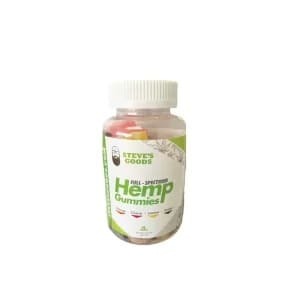
From the Steve’s Goods catalog: the gummies behind those COAs, and bulk and private-label gummy manufacturing.